Primary states
Uttar Pradesh, Bihar, West Bengal, Punjab
Texture
Light to medium loam — varies a lot across the deposit (sandy near rivers, finer in deltas)
pH
6.5–8 — Khadar near-neutral, Bhangar often slightly alkaline
🗺️ Where you'll find it
Geography
Covers about 30.4% of India's land. Found mainly across Uttar Pradesh, Bihar, West Bengal, Punjab, Haryana, Assam, Andhra Pradesh (delta), Tamil Nadu (delta), Odisha (delta).
Indo-Gangetic plain (Khadar & Bhangar)
Khadar = newer alluvium near rivers, finer, flooded most years. Bhangar = older alluvium away from the river, coarser, often carries white kankar nodules below the topsoil. Rice–wheat–sugarcane is the dominant rotation.
Brahmaputra valley
Annually re-laid by Brahmaputra floods. Higher organic matter from upstream forest litter than the IGP. Rice belt; small tea on uplands; jute on flood-prone fringes.
Coastal deltas (Krishna, Godavari, Cauvery, Mahanadi)
Heavier-textured delta clays. Salinity ingress at delta tips during low-flow months — paddy fields nearest the sea need salt-tolerant varieties.
👁️ Look & Feel
What you see, what you feel
Pick up a handful from the riverbank — it slides through your fingers, smooth, sometimes carrying faint silver flecks of mica. Walk away from the river and the soil grows older: paler, harder, sometimes carrying white kankar nodules in the layer below. The river writes its history into this soil, year after year.
Fresh Khadar near a Ganga riverbank — a thin silty layer left by the last flood.
Wikimedia Commons (CC-BY)
Older Bhangar profile showing white kankar (lime nodules) below the topsoil.
ICAR-NBSS&LUP
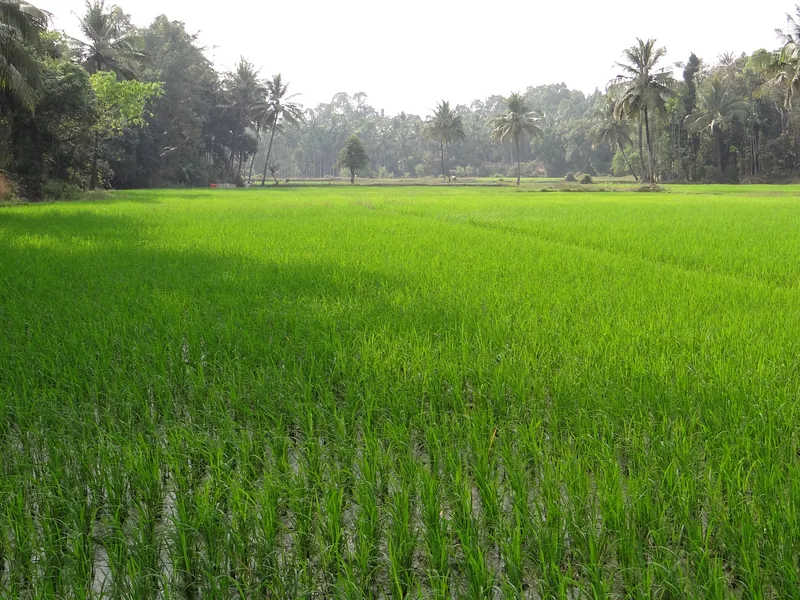
Paddy field on alluvium — Karnataka after the rains.
In hand: smooth, friable, holds a loose ball without sticking.
Mohan-uploaded (placeholder)
⚖️ Physical character
How it handles
Texture
Light to medium loam — varies a lot across the deposit (sandy near rivers, finer in deltas)
Structure
Friable; turns to a fine seedbed with one or two passes of light tillage
Depth
Deep, often more than 1.5 m
Drainage
Generally good; low-lying patches and old ox-bow channels stay waterlogged
Water-holding (mm/m)
100–180 mm — moderate; less than black soil but easier to work
Working the soil: Easy to work in most moisture conditions — one of the reasons cropping intensity here is so high. The soil forgives a little wet, a little dry.
🧪 Chemical character
The science behind it
pH range
6.5–8 — Khadar near-neutral, Bhangar often slightly alkaline
EC (dS/m)
Below 1 dS/m typically; saline patches in old canal commands of Punjab and Haryana
CEC (meq/100g)
10–25 meq per 100 g — moderate; nutrients don't hang around as long as on black soil
Free CaCO₃
Variable — common as kankar in Bhangar; absent in fresh Khadar
Scientific name: Soil scientists call the younger river-deposited layer an Entisol; the older Bhangar becomes an Inceptisol once it has had time to develop a sub-surface horizon.
🌿 Nutrient status
What's plenty, what's missing
Typical nutrient picture for this soil. For your specific field, always get the ICAR Soil Health Card.
0.4–0.7%
Decades of rice–wheat without rest have left the soil tired. Bring straw back instead of burning it; bring farmyard manure back every season.
Pale leaves before tillering tell you N is short. Split your urea into two or three doses — don't pour it all at sowing.
Drop fertiliser in a line beside the seed — not scattered across the field — and more of it reaches the plant.
The river-laid silt carries plenty of potassium. Most fields don't run short.
Rice and wheat both respond to a small dose of sulphur on intensively cropped fields. Yellowing of new leaves (not the old ones) is the sign.
Most Indo-Gangetic fields show a zinc shortage. Test once, treat at sowing — the effect lasts two to three seasons.
Generally adequate, but rice nurseries on calcareous Bhangar can show yellow-streaked seedlings — iron is locked up by the lime.
Adequate on most fields. Wheat and mustard near old saline patches sometimes show a boron shortage — a soil test confirms.
☔ Climate & water
What this soil expects
Rainfall this soil expects
Highly variable across the alluvial belt. Punjab and Haryana are hot semi-arid with low to moderate rainfall; central and eastern Uttar Pradesh and Bihar are sub-humid; Brahmaputra valley is humid to per-humid with very high rainfall; coastal deltas live with monsoon variability and cyclones. Almost no farmer on alluvium relies on rainfall alone — irrigation has been the rule for generations.
Irrigation — what crops need on this soil
Heavy canal and tube-well irrigation is the rule across the Indo-Gangetic plain; rice, wheat, sugarcane, and potato all depend on it. Brahmaputra valley is mostly rainfed because of high rainfall, with some shallow tube-wells. Coastal deltas share canal water with the river system. Salinity creeping into old canal commands of Punjab, Haryana, and parts of Andhra Pradesh deltas is the long-term irrigation risk.
Climate zones this soil sits in
Hot semi-arid (Punjab, Haryana, Delhi), hot sub-humid (most of Uttar Pradesh, Bihar, Bengal), warm humid to per-humid (Brahmaputra valley), and hot sub-humid tropical (coastal and deltaic plains). Long mild winters in the north allow rice–wheat double cropping; tropical winters in the deltas allow three crops a year.
🌾 Crops
What grows well here
Alluvial holds water in puddled fields and releases nutrients as the silt breaks down.
Tip: Direct-seeded rice saves water on lighter Khadar; transplanted rice fits heavier delta clays.
Rabi crop on residual moisture and irrigation; the fine seedbed is the alluvial soil's gift.
Tip: Two to three irrigations are usually enough; sow on time to escape March heat at grain-filling.
Deep alluvium and irrigation give cane the long growing season it needs.
Tip: Plant at moisture; trash mulch saves irrigation; ratoon two to three times before replanting.
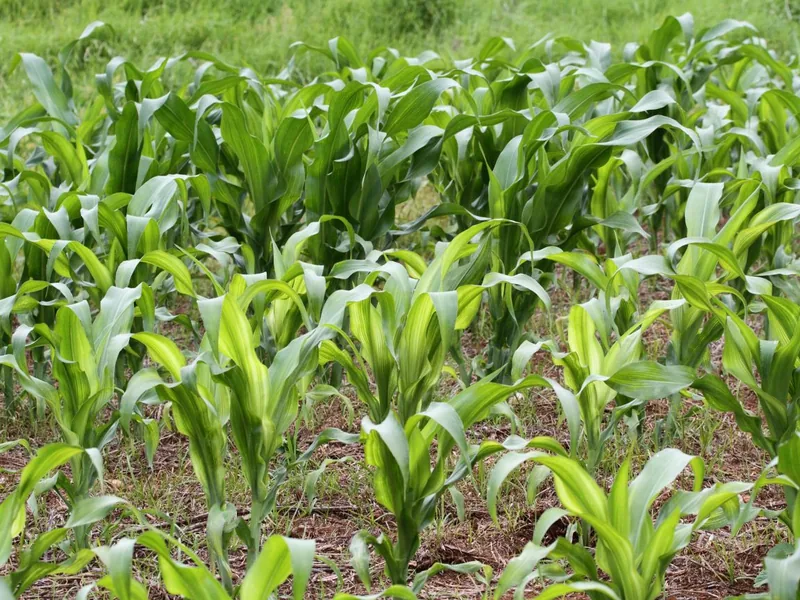
Bihar Khadar is a maize basket — the soil takes a quick kharif crop and a quick rabi one too.
Tip: Watch for zinc-deficiency white streaks in early growth; test once, treat once.
Rabi oilseed on residual moisture; survives the cold of north Indian winters.
Tip: A small dose of sulphur (gypsum or single super-phosphate) almost always pays back.
Rabi pulse on residual moisture; brings nitrogen back to a soil tired by rice–wheat.
Tip: Avoid waterlogged patches — chickpea wilts in poor drainage. Coat seed with rhizobium for free nitrogen.
Friable alluvium gives clean tubers — dig with a spade, no clods.
Tip: Earth up the ridges twice. Late blight needs a watch in foggy December weeks.
Loves the wet-then-dry rhythm of pre-monsoon and monsoon on light alluvium.
Tip: Sow with the first pre-monsoon shower; retting needs clean still water at harvest.
🍂 Deficiency signs
What the plant tells you
If you see these in your field, get your soil tested before adding inputs.
Zinc deficiencyజింక్ లోపం
Bronze-red patches on rice leaves a few weeks after transplanting; white streaks on young maize.
Bronzing of rice leaves, late vegetative stage — Bihar Khadar field.
ICAR-CRRI Cuttack
Zinc-deficient maize: white streaks between the leaf veins on young plants. Illustrative — actual symptoms vary.
What to do: A single zinc-sulphate dose at sowing covers two to three seasons. Confirm with a Soil Health Card — overdoing zinc damages the crop too.
Nitrogen deficiencyనత్రజని లోపం
Older lower leaves go pale yellow first; the plant looks tired and short.
Nitrogen-deficient rice: yellowing from the lower leaves up.
ICAR-CRRI Cuttack
Pale lower leaves on wheat at tillering — classic early-nitrogen shortage.
ICAR-IIWBR Karnal
What to do: Split urea into two or three doses across the crop's growth — pour it all at sowing and most of it leaks past the roots.
Sulphur deficiencyగంధకం లోపం
Top leaves yellow first — the opposite of nitrogen, where lower leaves go yellow.
Illustrative — actual symptoms vary. Mustard sulphur deficiency: yellowing top leaves and a cup-shaped leaf curl.
ICAR-DRMR (illustrative)
Sulphur-deficient wheat: pale top leaves, lower leaves still green.
ICAR-IIWBR Karnal
What to do: Mustard, wheat, and pulses respond well to a small dose of gypsum or single super-phosphate — both carry sulphur.
Iron chlorosis on calcareous Bhangarసున్నపు ఉన్న భూమిలో ఇనుము లోపం
Yellow-green streaks between the veins on young rice and groundnut leaves; older leaves stay green. The lime in the soil locks up iron.
Iron-chlorotic rice nursery on calcareous Bhangar — Punjab.
PAU Ludhiana
Illustrative — actual symptoms vary. Iron chlorosis in groundnut on calcareous soil.
ICAR-DGR (illustrative)
What to do: Foliar spray of iron sulphate — sprayed on leaves twice a week apart — works faster than soil application on lime-rich fields.
🛠️ Management
Practices that work for this soil
🌾Bring straw back, don't burn it
గడ్డి తిరిగి పొలంలో — కాల్చకండి Chop rice and wheat residue with a Happy-Seeder or a rotavator and mix it back into the topsoil before the next crop.
Why it helps: Burning straw destroys nutrients and microbes built up over the season. Chopping it back returns organic carbon, holds moisture, and slowly stops the soil from getting tired.
📏Laser land levelling
లేజర్తో నేలను సమం చేయుట Level the field with a laser-guided scraper before the kharif sowing — once every 3–5 years.
Why it helps: Even an unevenness of 5 cm wastes water and shows up as patchy yields. A levelled field uses 25% less water and gives a more uniform crop.
🔄Break the rice–wheat with a pulse or oilseed
వరి–గోధుమ చక్రాన్ని పప్పు లేదా నూనె గింజ పంటతో మార్చండి Once every two or three years, replace the rabi wheat with chickpea, lentil, or mustard.
Why it helps: Pulses pull nitrogen from the air. Mustard breaks the disease cycle that builds up under repeated wheat. The next wheat crop yields better.
✨Zinc once, well — not yearly
జింక్ ఒకసారి, సరిగ్గా — ప్రతి సంవత్సరం కాదు Apply 25 kg of zinc-sulphate per acre at sowing of the first kharif crop.
Why it helps: Zinc shortage is the most common micro-nutrient gap on alluvium. One properly-placed dose covers two to three seasons. Yearly broadcast wastes money.
🪴Farmyard manure or compost every season
పశువుల పేడ ఎరువు ప్రతి సీజన్ Well-rotted farmyard manure or compost, applied 2–3 weeks before sowing.
Why it helps: The river adds new soil every season; farmyard manure is what holds it together between floods.
🏛️ Government schemes
Support you may be eligible for
Note: Officially listed under 'Inceptisols' / 'Entisols' on government portals.
Pradhan Mantri Krishi Sinchayee Yojana — Per Drop More Crop
Department of Agriculture & Farmers Welfare
Subsidies for drip and sprinkler irrigation; level-field grants.
Visit portal →Crop Residue Management — Happy Seeder subsidy
State agriculture departments (Punjab, Haryana, UP)
Subsidy for the Happy-Seeder implement to sow wheat directly into standing rice stubble — no burning needed.
Visit portal →National Food Security Mission — Rice & Wheat
Department of Agriculture & Farmers Welfare
Production-support — seed, fertiliser, machinery subsidies for the rice–wheat belt.
Visit portal →💭 Common beliefs
What we hear — and what's true
Burn the rice straw — it's the fastest way to clear the field for wheat.
Burning rice straw destroys nutrients and microbes the soil has just built up. What looks like a clean field is a field that lost free fertiliser. A Happy-Seeder sows wheat directly into standing stubble; the stubble becomes mulch, holds moisture, and slowly returns organic carbon. Punjab and Haryana now subsidise the implement specifically to break this habit.
Why it matters: Each tonne of rice straw burnt gives up roughly 5 kilograms of nitrogen, 2 kilograms of phosphorus, 25 kilograms of potassium, and a kilogram of sulphur to the air. Multiplied across an acre of standing residue, that is fertiliser you would otherwise have bought. Plus the air-quality fines now levied in Punjab and Haryana.
More urea means more rice — it can't really hurt.
Rice fields use only 30–50% of the nitrogen they get from urea — the rest leaks into the air or the groundwater. Once a field is past its sweet spot, extra urea grows extra leaves, not extra grain. The crop becomes vulnerable to lodging in the wind and to leaf diseases that thrive on lush soft growth.
Why it matters: On a typical Indo-Gangetic rice field, splitting urea into two or three doses — instead of one big dose at sowing — uses less fertiliser and gives a better crop. Soil-test-based fertiliser plans through the Soil Health Card scheme often cut urea by 20–30% with no yield loss.
After 30 years of rice–wheat, the soil is just tired — that's the way it is.
Soil tiredness is not destiny — it is a balance sheet. Rice and wheat together pull about the same nutrients out every year; what they don't replace is what shows up as the slow yield plateau in Punjab and western Uttar Pradesh. Rotation with a pulse or oilseed, residue retention, and balanced micronutrients all push the balance back.
Why it matters: Fields that swap rabi wheat for chickpea or mustard once every two or three years see the next wheat crop yield more, not less. The pulse fixes nitrogen for free; mustard breaks the disease cycle. Both cost less to grow than wheat. Government scheme support is available through the National Food Security Mission for pulse seed and machinery.
📚 Sources
Where this comes from
Sourced only from ICAR, NBSS&LUP, SAU, KVK, and ICRISAT. Wayback Machine snapshot links preserve citations against URL rot.
bookMishra, B.B. (Ed.). (2020). The Soils of India. Springer Nature Switzerland.
Canonical contemporary Indian soil science reference.
extension-pubWheat package of practices for the Indo-Gangetic Plain
link extension-pubSugarcane production technology
link extension-pubPulses on rice–wheat rotation
link government-portalSoil Health Card scheme — find your nearest test centre
link
A note — This page is an educational guide built from public extension materials. It is not a prescription. Your soil is unique. For specific fertilizer or amendment decisions, get your soil tested and consult your nearest KVK or local agriculture extension officer.