Primary states
Rajasthan (western), Gujarat (Kutch), Haryana (south), Punjab (south-west fringes)
Texture
Sandy to sandy loam — over 70% sand in the dune country
🗺️ Where you'll find it
Geography
Covers about 8.0% of India's land. Found mainly across Rajasthan (western), Gujarat (Kutch), Haryana (south), Punjab (south-west fringes).
Thar core
Sand-dune country. Annual rainfall under 250 mm. Bajra, guar, moth bean, and shelter-belt agroforestry (khejri) carry the cropping system.
Marwar transition (semi-arid fringe)
Sandy loam between dune country and the irrigated canal commands. Rainfall 250–500 mm. Mustard, cumin, fennel, isabgul, irrigated wheat where canal water reaches.
Kutch
Mix of sandy and saline patches; the Rann salt flat sits on its eastern edge. Cotton, castor, cumin, dates, and salt-tolerant fodders.
👁️ Look & Feel
What you see, what you feel
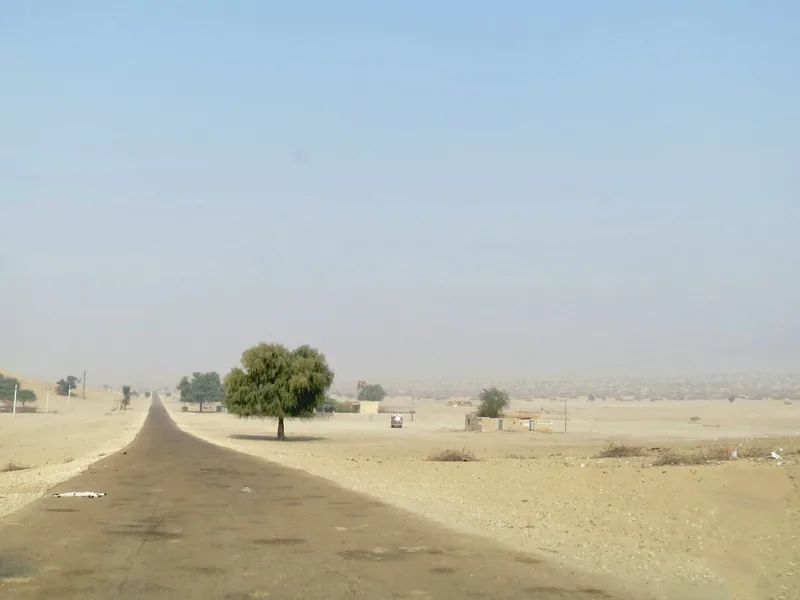
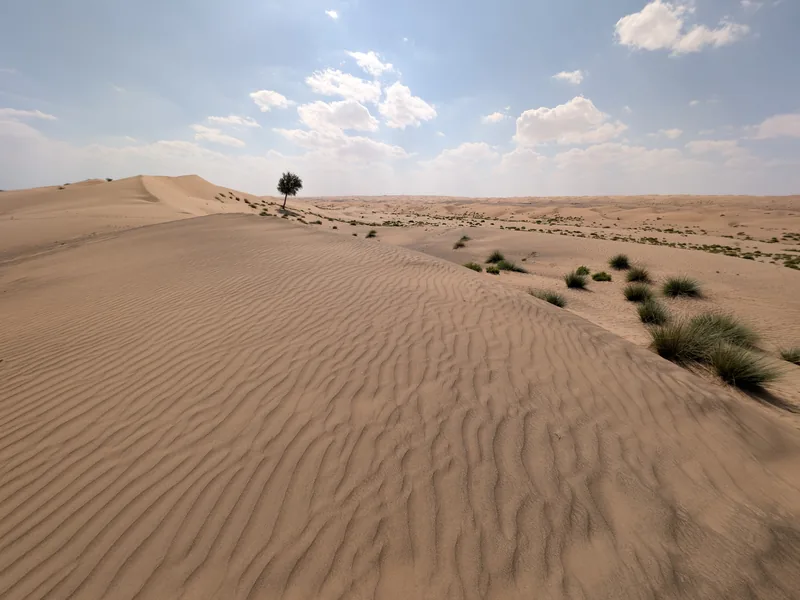
Run sand between your fingers and feel how quickly water moves through it — a field forgets a shower in half a day. The colour is pale, almost beige; in the hot afternoon, the surface shimmers like silver. This is the soil of survival, not abundance. Crops that succeed here are the ones that have made peace with thirst.
Cultivated patches in the Thar Desert near the India–Pakistan border.
Khejri tree (Prosopis cineraria) — the keystone tree of Thar Desert farming.
Sandy profile with a thin organic layer at the top — Marwar transition.
ICAR-NBSS&LUP
In hand: pale, gritty, runs through fingers without holding any shape.
Mohan-uploaded (placeholder)
⚖️ Physical character
How it handles
Texture
Sandy to sandy loam — over 70% sand in the dune country
Structure
Single-grained, loose; no clods even when wet
Depth
Very deep (often >2 m) but uniformly sandy through the profile
Drainage
Excessive — water reaches the deep watertable in days, not weeks
Water-holding (mm/m)
40–80 mm — among the lowest in India
Working the soil: Easy to work in any condition, but the wind is the real enemy. A bare field loses topsoil to a single sandstorm. Keep the surface covered, always.
🧪 Chemical character
The science behind it
pH range
8.0–9.0 (alkaline)
EC (dS/m)
Variable — fresh sandy patches under 1 dS/m, but saline patches near the Rann and on old canal commands can be 4–8 dS/m
CEC (meq/100g)
3–8 meq per 100 g — very low; fertiliser leaks past in days without organic matter to hold it
Free CaCO₃
Common in Marwar (5–15%); variable in Kutch
Scientific name: Soil scientists classify these as Aridisols — soils where rainfall is too low for full leaching, leaving salts and lime concentrated in the profile.
🌿 Nutrient status
What's plenty, what's missing
Typical nutrient picture for this soil. For your specific field, always get the ICAR Soil Health Card.
0.1–0.3%
Among the lowest in India. Every gram of farmyard manure, every leaf of khejri litter that goes back to the field counts. Without organic matter, fertiliser is wasted.
N leaks past these sandy soils faster than any other in India. Apply small doses, often, and only when the soil has moisture to hold the crop.
Drop it in a line beside the seed — broadcast P stays on dry sand and never reaches the root.
The desert sand is K-rich from the parent rocks. Most fields don't run short of K.
Mustard especially responds. Yellowing of new leaves (not the old ones) is the sign — gypsum is the cheap answer.
Worth a soil test on continuously cropped fields. A zinc shortage is one of the silent yield-eaters in irrigated arid pockets.
On calcareous Marwar patches, lime locks up iron. Foliar spray of iron sulphate works fastest where soil application doesn't.
Variable — confirm with a soil test before adding. Cumin and isabgul respond on B-deficient patches.
☔ Climate & water
What this soil expects
Rainfall this soil expects
The Thar core gets less than 250 millimetres a year — among the lowest in India — and that rain comes in a few days of the south-west monsoon. The Marwar transition fringe gets 250 to 500 millimetres, still aridic but with more reliable cropping. Kutch sits in the same range with a strong cyclone-driven rain pattern. Rain is almost never enough on arid soil; survival is built on storing it.
Irrigation — what crops need on this soil
Indira Gandhi Nahar Pariyojna canal water transformed parts of western Rajasthan into wheat-mustard country. Drip and sprinkler are now the standard for serious irrigators because flood on sand both wastes water and drives long-term salinity. Outside canal commands, tanka and khadin water-harvesting carry the household and one rabi crop respectively — these are centuries-old desert engineering still in use.
Climate zones this soil sits in
Hot arid (Thar core: Jaisalmer, Bikaner, Barmer; Kutch: Bhuj). Hot semi-arid transition (Marwar: Jodhpur, Pali, Nagaur). Summer temperatures above 45°C and winter nights near freezing both extreme; dry air, low humidity, fierce sandstorms in pre-monsoon weeks. Climate, more than soil, sets the cropping calendar here.
🌾 Crops
What grows well here
The most drought-tolerant cereal in Indian farming. Survives on 200–300 mm of rain a year.
Tip: Sow within a week of the first monsoon shower; use local varieties bred for short rains.
Pulse and gum crop in one — tolerates sand, low rainfall, and high temperatures.
Tip: Coat seed with rhizobium for free nitrogen. Sow with the first reliable shower.
Among the most heat- and drought-tolerant pulses in India.
Tip: Sow in mixed-crop fields with bajra; harvest before the soil completely dries.
Rabi oilseed on residual moisture and short irrigation; the cool Rajasthan winter suits it.
Tip: A small dose of sulphur (gypsum or single super-phosphate) almost always pays back here.
Rabi spice on light soils; dry climate keeps the seed disease-free.
Tip: Sow in October–November; avoid waterlogging — cumin rots in wet patches.
Rabi spice that loves the Marwar transition's medium soils and short irrigation.
Tip: Two irrigations are usually enough; harvest just as the seed turns greenish-brown.
Irrigated rabi crop where canal water reaches — Indira Gandhi Nahar and the older commands.
Tip: Light frequent irrigation beats heavy flooding on these sandy soils.
Deep tap-root reaches sub-soil moisture; tolerates the heat of Kutch.
Tip: Plant on light ridges; thin to one plant per hill. Castor is a long-season crop — keep weeding for the first two months.
🍂 Deficiency signs
What the plant tells you
If you see these in your field, get your soil tested before adding inputs.
Nitrogen deficiencyనత్రజని లోపం
Older lower leaves go pale yellow first; plants stay short and slow to tiller. Worst on rainfed bajra in poor monsoon years.
Nitrogen-deficient bajra: pale lower leaves, short plant — Thar core, late kharif.
ICAR-CAZRI Jodhpur
Pale lower leaves on wheat at tillering — irrigated Marwar field.
ICAR-IIWBR Karnal
What to do: Split your urea into 2–3 small doses across the crop. On sand, one big dose washes through to the watertable — the crop sees almost none of it.
Sulphur deficiencyగంధకం లోపం
Top leaves yellow first — opposite of nitrogen. Mustard especially shows it.
Illustrative — actual symptoms vary. Mustard sulphur deficiency: yellowing top leaves with cup-shaped curl.
ICAR-DRMR (illustrative)
Illustrative — actual symptoms vary. Sulphur-deficient cumin: pale top growth, weak stems.
ICAR-NRCSS (illustrative)
What to do: Gypsum at sowing is the cheap, durable answer — 100–150 kg per acre. Single super-phosphate also carries S along with the P.
Iron chlorosis on calcareous patchesసున్నపు భూమిలో ఇనుము లోపం
Yellow-green streaks between the veins on young leaves; older leaves stay green. The lime in the soil locks up iron.
Iron-chlorotic groundnut on calcareous Marwar field.
ICAR-DGR Junagadh
Illustrative — actual symptoms vary. Iron-chlorotic wheat — interveinal yellowing.
ICAR-IIWBR (illustrative)
What to do: Foliar spray of iron sulphate — sprayed on the leaves twice, a week apart — works faster than soil application on lime-rich sandy fields.
🛠️ Management
Practices that work for this soil
🌳Khejri-based agroforestry
ఖేజ్రి చెట్ల సహ-సాగు Keep one Prosopis cineraria (khejri) tree every 8–10 m across the field. Don't cut them; lop the leaves for fodder.
Why it helps: Khejri is the desert farmer's tree. Its deep roots don't compete with crops; its leaves return nitrogen-rich litter; its shade brings the field temperature down by 2–4°C. Yields under khejri are often higher than yields outside.
🌬️Sand-dune stabilisation with shelter belts
ఇసుక దిబ్బలను చెట్ల వరుసలతో స్థిరపరచుట Plant lines of hardy shrubs and trees (Acacia tortilis, Prosopis juliflora, ber) perpendicular to the wind direction at the field's windward edge.
Why it helps: Wind erosion is the desert's quiet thief — it carries away the topsoil and the seed both. A shelter belt of even 5 m height cuts wind speed in the leeward field by half, and the field holds its sand and its crop.
💧Drip and sprinkler over flood
ఫ్లడ్ నీటిపారుదల కంటే డ్రిప్ / స్ప్రింక్లర్ Use drip lines for row crops (cumin, mustard, cotton, vegetables) and sprinklers for cereals (wheat). Avoid open flooding on sandy soils.
Why it helps: On sand, flood irrigation puts most of the water past the root zone in hours. Drip and sprinklers give the same crop yield with less than half the water — and the salt that comes with the water doesn't pile up in the topsoil as fast.
🪴Farmyard manure and crop-residue mulch
పశువుల పేడ ఎరువు మరియు పంట అవశేషాలతో మల్చ్ Apply farmyard manure at sowing, and spread crop residue (bajra stalk, mustard straw) on the surface as mulch.
Why it helps: In dry soil, farmyard manure is a sponge. It holds the next rain longer than bare sand can.
🪣Rainwater harvesting — tanka and khadin
వర్షపు నీటిని నిల్వ చేయుట (టాంకా / ఖదీన్) Build a tanka (covered cistern) at the household for drinking water. Build a khadin (low earth bund across a small valley) to catch rainwater for one rabi crop.
Why it helps: These are the desert farmer's own inventions — refined over centuries. A tanka stores monsoon rain through the dry months. A khadin holds runoff long enough for one rabi crop on the silt that settles. Both are still the cheapest water-security investments in arid India.
🏛️ Government schemes
Support you may be eligible for
Note: Officially listed under 'Aridisols' / 'Entisols' on government portals.
Integrated Watershed Management Programme
Department of Land Resources / state rural development
Watershed-scale soil-and-water conservation — bunds, percolation tanks, pasture development, agroforestry.
Visit portal →National Mission for Sustainable Agriculture — Rainfed Area Development
Department of Agriculture & Farmers Welfare
Drought-proofing — water harvesting, rainfed crop choice, livestock-crop integration.
Visit portal →Indira Gandhi Nahar Pariyojna
Government of Rajasthan + Ministry of Jal Shakti
Canal-irrigated wheat–mustard belt in western Rajasthan. Includes drainage and salinity-management add-ons.
Visit portal →💭 Common beliefs
What we hear — and what's true
Desert soil can't really hold nutrients — there's no point spending on a soil test or fertiliser.
Sand leaks water and nutrients faster than any other soil — but that means how you apply matters more, not less. Split nitrogen into small doses timed to crop stage, drop phosphorus in a line beside the seed, and put farmyard manure back every season as a sponge to hold what comes next. Trials at the Central Arid Zone Research Institute in Jodhpur have shown bajra yields rising with this discipline even on the same Thar field.
Why it matters: The cost of accepting low yields is permanent low yields. The cost of careful fertiliser use is lower than careless use, because most of the wasted urea on broadcast sand never reaches the crop in the first place. The Soil Health Card scheme issues a free soil test every three years; it pays for itself in fertiliser savings within a single season on these soils.
Khejri trees compete with my crop for water — I should clear them.
Khejri (Prosopis cineraria) is the desert farmer's tree precisely because it doesn't compete. Its tap root reaches deep below the crop root zone; its leaves fall and feed nitrogen back to the field; its shade brings field temperatures down by 2 to 4 degrees Celsius in the hottest weeks. Bajra and pulses under khejri canopy often yield more than the same crops in the open.
Why it matters: Cutting khejri is illegal in much of Rajasthan because of its ecological role — but more practically, cutting it gives up free fertiliser, free shade, and free fodder. A planted field with one khejri every 8 to 10 metres gets all three without losing crop area worth speaking of. The Central Arid Zone Research Institute treats khejri-based agroforestry as the foundational arid management practice.
Canal water from Indira Gandhi Nahar is unlimited — I can flood the field freely.
Sand cannot hold flood water — it goes past the root zone in hours. So the same yield needs roughly half the water under drip or sprinkler as under flood. Worse, every flood irrigation deposits a little salt on the soil surface as the water evaporates. Older Indira Gandhi Nahar commands now show salinity that didn't exist when canal water first arrived — the soil saved every gram the water brought.
Why it matters: Salinity is hard to reverse. By the time salt patches start showing up, the field has lost yield potential that takes years to recover even with gypsum and drainage. Pradhan Mantri Krishi Sinchayee Yojana — Per Drop More Crop subsidises drip and sprinkler systems specifically to head off this trap. The early adopter saves the field; the late adopter spends years reclaiming it.
📚 Sources
Where this comes from
Sourced only from ICAR, NBSS&LUP, SAU, KVK, and ICRISAT. Wayback Machine snapshot links preserve citations against URL rot.
bookMishra, B.B. (Ed.). (2020). The Soils of India. Springer Nature Switzerland.
Canonical contemporary Indian soil science reference; arid coverage limited — CAZRI is the primary anchor.
extension-pubArid soils of western Rajasthan
link extension-pubPearl millet (bajra) production technology
linkarchived extension-pubMustard / rapeseed package of practices
link extension-pubSeed spices — cumin, fennel, isabgul
link government-portalSoil Health Card scheme — find your nearest test centre
link
A note — This page is an educational guide built from public extension materials. It is not a prescription. Your soil is unique. For specific fertilizer or amendment decisions, get your soil tested and consult your nearest KVK or local agriculture extension officer.