Loading soil details…
Share of India
16.6%
Primary states
Maharashtra (largest area), Madhya Pradesh, Gujarat, Telangana
Texture
Clayey — 40–60% clay, mostly smectite (the clay that swells)
pH
7.5–8.5 — slightly on the alkaline (lime-rich) side.
🗺️ Where you'll find it
Geography
Covers about 16.6% of India's land. Found mainly across Maharashtra (largest area), Madhya Pradesh, Gujarat, Telangana, Karnataka (north), Andhra Pradesh (Anantapur belt).
Vidarbha & Marathwada
Deep soil that drains well, with some lime in it. Rainfed cotton–soybean–tur belt. Most farmers wait for the first monsoon week before sowing — moisture timing is everything here.
Malwa & Nimar
Deep, often slightly more clayey than Vidarbha. Soybean–wheat double-cropping where canal or tube-well irrigation reaches; rainfed soybean–chickpea otherwise.
Saurashtra coast & Kathiawar fringe
Medium-deep black soil meeting the Arabian Sea. Salt rises up with the underground water (the watertable) on coastal patches; cotton and groundnut still dominate, but drainage and salt-tolerant varieties matter more here than inland.
👁️ Look & Feel
What you see, what you feel
When dry, the surface cracks open in wide grooves you can put your hand into. After the first big rain, the soil swells and those cracks close shut. That swelling-and-shrinking is the signature of black soil — and what makes it both forgiving and demanding.
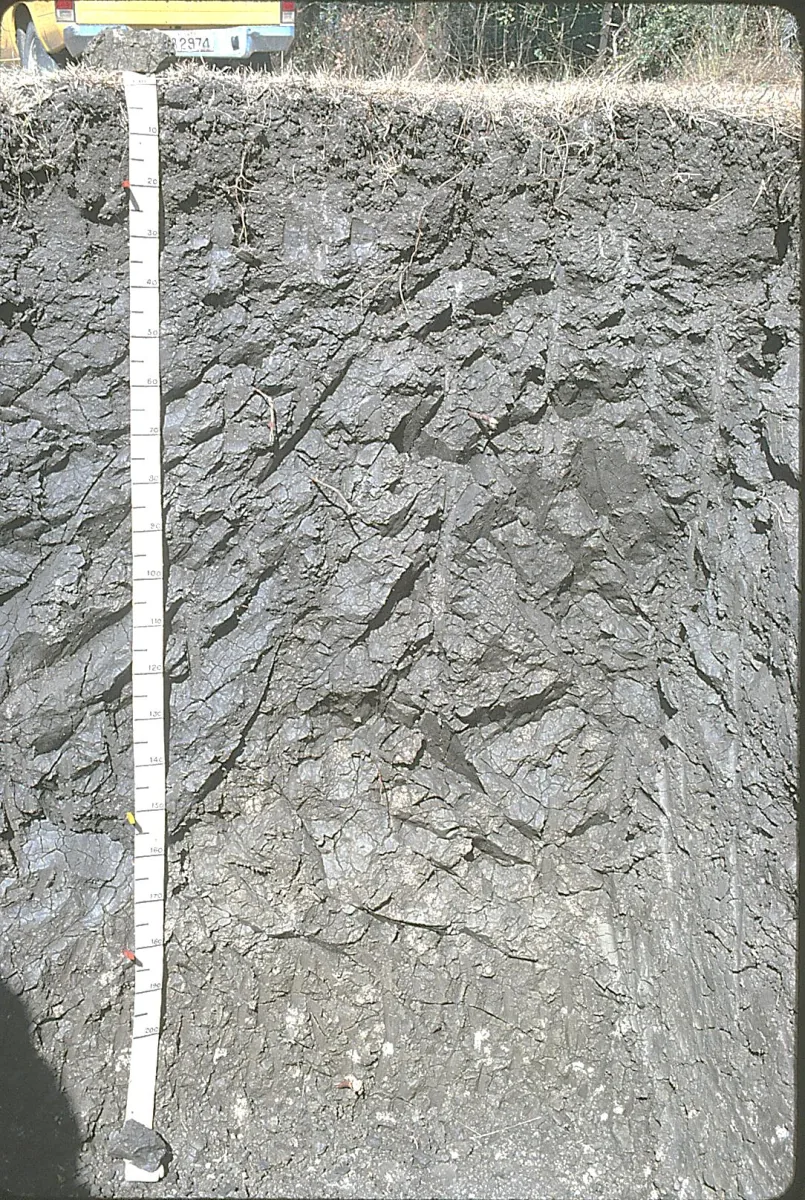
A black-soil pit dug at ICRISAT's research farm near Hyderabad. The dark layer goes down more than a metre — what farmers feel when their plough strikes a hard layer below. The wedge-shaped lumps on the right are how this soil breaks after years of swelling in monsoon and shrinking in summer.
SoilScience.info / USDA-NRCS via Flickr (CC-BY-2.0)

In hand: smooth, plastic, holds its shape when you press a ball of it.
Mohan-uploaded (placeholder)
⚖️ Physical character
How it handles
Texture
Clayey — 40–60% clay, mostly smectite (the clay that swells)
Structure
Crumbly when dry, sticky when wet. The deep summer cracks let fresh air down to where the roots live.
Depth
Deep to very deep — over 1 m in most areas
Drainage
Drains slowly in heavy rain — water sits on top before it soaks in. In summer, the cracks let fresh air reach the roots.
Water-holding (mm/m)
180–250 mm — among the highest in India
Working the soil: Only easy to plough in a short window — too wet, the soil sticks to everything; too dry, it's like brick. Time your ploughing to the first week or two after a good monsoon shower.
🧪 Chemical character
The science behind it
pH range
7.5–8.5 — slightly on the alkaline (lime-rich) side.
EC (dS/m)
Below 1 dS/m on most fields — that's a low salt level. Coastal pockets in Saurashtra can read higher; that's salt rising up with the underground water.
CEC (meq/100g)
40–60 meq per 100 g — high; the soil grips nutrients well once they reach it
Free CaCO₃
5–15% lime is common; some patches go up to 25% lime.
Scientific name: Soil scientists classify this as a Vertisol — a swelling-clay soil. The label travels in research papers; in the field, you already know it by the cracks.
🌿 Nutrient status
What's plenty, what's missing
Typical nutrient picture for this soil. For your specific field, always get the ICAR Soil Health Card.
Organic Carbon
low
0.2–0.5%
Add farmyard manure or green manure every season — the soil burns through organic matter fast because the heat speeds it up.
Nitrogen (N)
low
Crops show pale lower leaves first.
Phosphorus (P)
low
Drop fertiliser in a line beside the seed — not scattered — and more of it reaches the plant. The soil's lime grabs phosphorus that's left on the surface.
Potassium (K)
adequate
The dark rock the soil came from carries plenty of potassium — so most fields don't show a potassium shortage.
Sulphur (S)
marginal
Soybean, mustard, and pulses respond — yellowing of new leaves (not the old ones) is the sign of a sulphur shortage.
Zinc (Zn)
low
Sorghum shows white-bud, maize shows white streaks between leaf veins.
Iron (Fe)
adequate
The dark rock under the soil is iron-rich — iron shortage is rare on black soil.
Boron (B)
adequate
Variable in coastal pockets — confirm with a soil test before adding.
☔ Climate & water
What this soil expects
Rainfall this soil expects
Black soil sits across hot semi-arid and hot sub-humid zones. In Vidarbha and Malwa, the monsoon is what fills the soil's water bank for the rainfed kharif crop. Where rainfall stays low through the season, only deep-rooted crops like pigeonpea and sorghum stay reliable; everything else needs irrigation.
Irrigation — what crops need on this soil
Rainfed kharif cotton, soybean, and pulses are the rule on Vidarbha and Malwa black soil. Rabi wheat in Malwa needs canal or tube-well irrigation. On the Saurashtra coast, drip or sprinkler pays back fast — black soil is heavy and easy to over-water with flood irrigation, and over-irrigated black soil develops salt and alkalinity over time.
Climate zones this soil sits in
Hot semi-arid (most of Vidarbha and north Karnataka), hot sub-humid (Malwa, parts of Telangana), and the arid coastal belt of Saurashtra. Hot summers and a sharp monsoon are what give the soil its swell-and-crack rhythm. Long mild winters in Malwa allow rabi wheat and chickpea on residual moisture — something Vidarbha black soil can't match because of its drier rabi season.
🌾 Crops
What grows well here
Cotton
High water-holding lets cotton ride out dry spells of 10–14 days.
Tip: Wait for the first good monsoon shower before sowing; raised beds (broad bed and furrow) keep the crop above waterlogged patches in heavy rain.
Soybean
Short-season crop fits the rainfed kharif window on deep black soil.
Tip: Coat the seed with rhizobium powder before sowing — it brings free nitrogen to the crop. A small dose of sulphur also helps.
Pigeon Pea
Deep root reaches stored sub-soil moisture after the rains stop.
Tip: Plant rows of pigeonpea between cotton or soybean — the pulse pulls nitrogen out of the air and shares it with its neighbour.
Chickpea
Rabi crop on residual moisture — black soil's water bank carries it through.
Tip: Sow on residual moisture after kharif; rabi temperatures suit grain filling.
Jowar
Drought-tolerant; gives both grain and fodder on rainfed black soil.
Tip: Watch for zinc deficiency in early growth — white-bud is the warning sign.
Wheat
Irrigated rabi crop on Malwa black soil — the soil's water holding stretches each irrigation.
Tip: Two to three irrigations are usually enough; deep summer tillage helps root growth.
Groundnut
Tolerates the hot dry spells once established; calcium from soil lime helps pod filling.
Tip: Avoid waterlogged patches — pod rot is a risk in heavy rain years. On Saurashtra coast, watch for salt rising up with the watertable.
Safflower
Rabi crop on residual moisture; deep tap root reaches sub-soil water.
Tip: Sow after kharif harvest, irrigate only if the soil dries before flowering.
🍂 Deficiency signs
What the plant tells you
If you see these in your field, get your soil tested before adding inputs.
Nitrogen deficiencyనత్రజని లోపం
Lower leaves go pale yellow first; the plant looks tired and short.

Nitrogen-deficient cotton — lower leaves yellowing, Vidarbha late August.
ICAR-CICR Nagpur

Nitrogen-deficient jowar showing pale uniform yellowing.
ICRISAT Patancheru
What to do: Confirm with Soil Health Card; ask your local Krishi Vigyan Kendra (the local farm science centre) before adding urea. A split application gives better response than one big dose.
Phosphorus deficiencyఫాస్ఫరస్ లోపం
Older leaves take on a dull purple or bronze tinge; plants stay short and slow to flower.

Illustrative — actual symptoms vary. Pigeonpea phosphorus deficiency: dull leaves, stunted plants.
ICAR-IIPR (illustrative)

Phosphorus-deficient soybean: small dark-green leaves, slow to flower.
ICAR-IISR Indore
What to do: Phosphorus stays where you put it on this soil — drop it in a line near the seed for the best response on lime-rich black soil.
Sulphur deficiencyగంధకం లోపం
Top leaves yellow first — the opposite of nitrogen deficiency, where lower leaves go yellow.

Sulphur-deficient soybean: top leaves pale, lower leaves still green.
ICAR-IISS Bhopal

Illustrative — actual symptoms vary. Mustard sulphur deficiency: yellowing top leaves and a cup-shaped leaf curl.
PJTSAU (illustrative)
What to do: Soybean, mustard, and pulses respond well to a small dose of gypsum or single super-phosphate (which carries sulphur).
Zinc deficiencyజింక్ లోపం
White or pale streaks between the leaf veins on young leaves; the growing tip can die back.

White-bud symptom in sorghum — the classic sign of zinc deficiency on black soil.
ICRISAT Patancheru
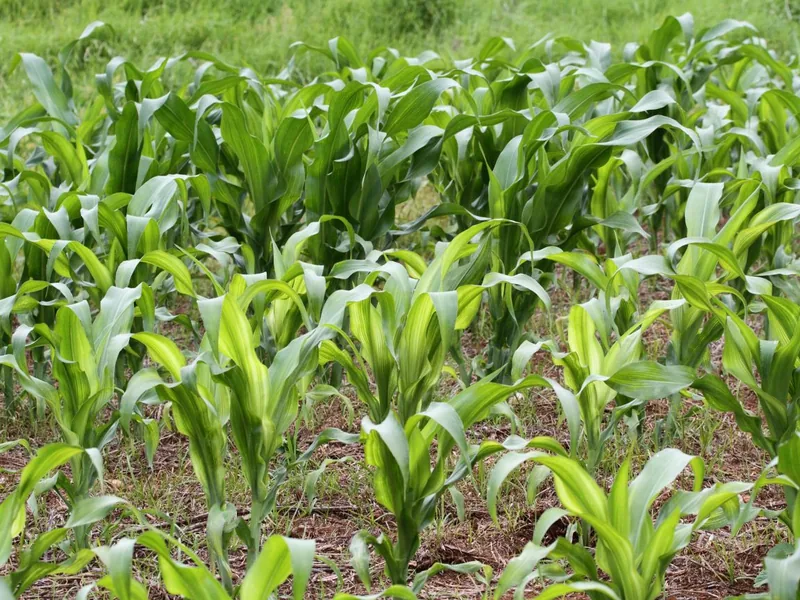
Interveinal chlorosis in maize on black soil. Illustrative — actual symptoms vary.
What to do: Common on continuously cropped black soils. Zinc sulphate at sowing — talk to your Krishi Vigyan Kendra for the right dose for your area.
🛠️ Management
Practices that work for this soil
Broad bed and furrow
విశాల పడకలు మరియు చాలుRaised beds about 1 m wide separated by furrows. Crops grow on the beds; furrows take excess rain.
Why it helps: Black soil drowns its own roots in heavy rain. Broad bed and furrow gives water somewhere to go. Yields rise 15–25% in wet years on black soil.
Summer ploughing
వేసవి దున్నుటDeep ploughing once during the hot summer months — when the soil is dry and cracked.
Why it helps: Breaks the hard layer below the surface, exposes hidden pest eggs and pupae (insect cocoons) to the sun, and lets the first rain soak deep instead of running off.
Green manure with sunhemp or dhaincha
ఆకుపచ్చని ఎరువు — జనుము / దైంచSow sunhemp (Crotalaria) or dhaincha (Sesbania) before the main crop. At flowering, plough it back in.
Why it helps: Adds organic carbon back to a soil that loses it fast. Brings nitrogen with it, free from the air. Costs less than buying urea.
Farmyard manure or compost every season
పశువుల పేడ ఎరువు ప్రతి సీజన్Well-rotted farmyard manure or compost, applied 2–3 weeks before sowing.
Why it helps: Black soil burns through organic matter fast. Farmyard manure every season is what keeps it from going hungry.
Drainage on irrigated and coastal patches
నీరు తీసే ఏర్పాటుOpen drains every 30–50 m where black soil meets the coast or where canal water pools. A slope of 1 in 1000 is enough.
Why it helps: Black soil holds water — useful in drought, dangerous in a wet year. Coastal patches also face salt rising up with the watertable.
🏛️ Government schemes
Support you may be eligible for
Note: Officially listed under 'Vertisols' on government portals.
National Food Security Mission — Pulses (Tur, Chickpea)
Department of Agriculture & Farmers Welfare
Subsidies for seed, balanced fertiliser plans, pest management, and farm machinery — for tur, chickpea, and other rabi pulses grown on rainfed black soil.
Visit portal →National Cotton Development Mission
Ministry of Textiles, with technical support from the Indian Council of Agricultural Research — Central Institute for Cotton Research
Helps cotton growers with new techniques, raised-bed (broad bed and furrow) training, pest management, and post-harvest support on black soil.
Visit portal →Pradhan Mantri Krishi Sinchayee Yojana — Per Drop More Crop
Department of Agriculture & Farmers Welfare
Subsidies on drip and sprinkler systems — pays back fast where canal or tube-well water reaches black soil.
Visit portal →💭 Common beliefs
What we hear — and what's true
Black soil is fertile — my grandfather grew cotton without urea, so I don't need it either.
Black soil holds nutrients tightly, but it's actually low in nitrogen, phosphorus, organic carbon, and zinc. The dark colour comes from iron and lime in the parent rock — not from a stock of plant food. When farmers skip fertiliser and farmyard manure, yields slide a little every year. Most blame the weather instead of the missing inputs.
Why it matters: Cotton on black soil needs balanced fertiliser plus regular farmyard manure every season. Without these, yields decline gradually over the years. The single biggest fix is farmyard manure every season — black soil burns through organic carbon fast in the heat, and farmyard manure is what keeps the soil from going hungry.
Black soil has every nutrient cotton needs. Zinc fertiliser is for sandy soils, not for us.
Black soil is rich in iron and potassium — the dark rock under it carries them. But zinc gets locked up by the soil's lime content; the plant can't reach it even when it's there. Continuous cotton, jowar, and maize pull more zinc out of the soil than it can release back. Government soil-testing data lists most major Vidarbha cotton districts — Yavatmal, Akola, Amravati, Wardha, Nagpur, Buldhana, Chandrapur — as zinc-deficient.
Why it matters: Zinc-short cotton grows small leaves and stays shorter than its neighbour — easy to mistake for water stress. Zinc sulphate at sowing is the standard fix. Confirm with a Soil Health Card test first — it's a one-time-per-season correction, not an annual one.
Broad bed and furrow is for big farms with tractors. My 2-acre plot doesn't need it — the old flat layout works fine for us.
Broad bed and furrow is actually more useful on small plots, not less. A wet-year drowning hits the same percentage of crop on small farms as on big ones — but a small farm can't absorb the loss as easily. Bullock-drawn raised-bed formers are available through cooperatives, and the beds last the full season once shaped.
Why it matters: On a flat plot in a wet year, waterlogging can wipe out a meaningful part of the crop in two weeks. Raised beds lift the crop above standing water. Ask your Krishi Vigyan Kendra about a shared raised-bed former — most Vidarbha and Malwa districts have one within reach.
📚 Sources
Where this comes from
Sourced only from ICAR, NBSS&LUP, SAU, KVK, and ICRISAT. Wayback Machine snapshot links preserve citations against URL rot.
bookMishra, B.B. (Ed.). (2020). The Soils of India. Springer Nature Switzerland.
Canonical contemporary Indian soil science reference.
monographVertisols: Their Properties, Classification, and Management (El-Swaify et al.)link
technical-bulletinBroad-Bed-and-Furrow technical bulletinlink
extension-pubCotton in Vertisols — agronomy and nutrient managementlink
extension-pubSoybean on Vertisols — package of practiceslink
government-portalSoil Health Card scheme — find your nearest test centrelink
A note — This page is an educational guide built from public extension materials. It is not a prescription. Your soil is unique. For specific fertilizer or amendment decisions, get your soil tested and consult your nearest KVK or local agriculture extension officer.