Primary states
Kerala, Karnataka (Western Ghats slopes), Maharashtra (Konkan, Goa border), Goa
Texture
Gravelly clay loam — fine clay matrix holding hard iron-aluminium nodules
🗺️ Where you'll find it
Geography
Covers about 7.5% of India's land. Found mainly across Kerala, Karnataka (Western Ghats slopes), Maharashtra (Konkan, Goa border), Goa, Odisha (eastern hills), Meghalaya, Assam (hill margins).
Konkan & Malnad
Heavy monsoon, deeply weathered laterite; rice in valleys, cashew and mango on slopes, areca nut and coconut on better-watered terraces.
Malabar coast
Highest rainfall in India; coconut, areca, pepper, rubber, banana, tapioca dominate. Acidity is the central management problem.
Eastern hills (Odisha–Meghalaya)
Shifting cultivation (jhum) historically dominant; settled cultivation expanding with terracing. Rice, ginger, turmeric, large cardamom, pineapple.
👁️ Look & Feel
What you see, what you feel
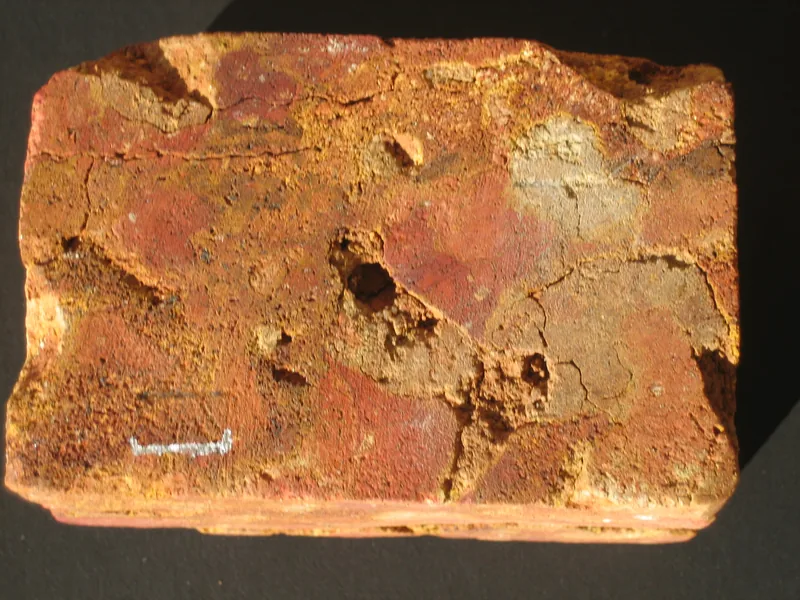
After heavy rain, you can see how this soil carries gravelly red clumps that almost ring when you tap them — like brick. That hardness is no accident. Centuries of monsoon have washed away the soft minerals and left behind iron and aluminium oxides. This soil is the mountain's resistant skin.
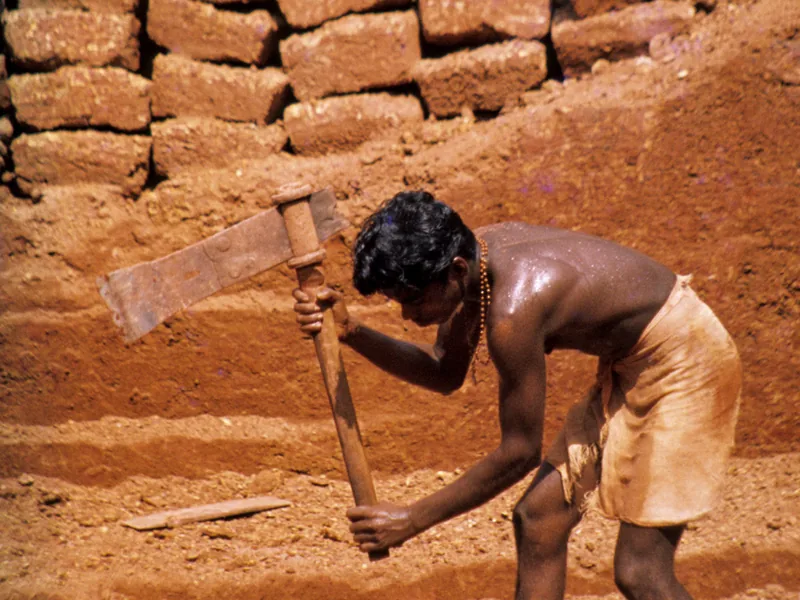
Active laterite quarry, Angadipuram — cutting brickstones from the cliff face.
Paddy fields in a laterite valley, Malabar — the only patches that hold water all season.
KAU Vellanikkara
Laterite cut into building blocks — the same soil that makes hard work for the plough makes easy work for the mason.
In hand: gritty, rust-coloured, with small gravel pieces that don't crush.
Mohan-uploaded (placeholder)
⚖️ Physical character
How it handles
Texture
Gravelly clay loam — fine clay matrix holding hard iron-aluminium nodules
Structure
Open, porous; the gravel keeps the soil from forming dense clods
Depth
Variable — deep in valley terraces, shallow on hill slopes (often <50 cm)
Drainage
Excessive on slopes; the soil drains so fast that even heavy rain doesn't always reach the root zone
Water-holding (mm/m)
60–120 mm — low; mulch and organic matter make a real difference
Working the soil: The gravel makes ploughing slow and breaks tools. Many farmers grow tree crops instead — once a coconut or cashew tree is established, you don't plough the soil again.
🧪 Chemical character
The science behind it
EC (dS/m)
Below 0.5 dS/m; salinity is rare except where seawater intrudes on coastal estuaries
CEC (meq/100g)
3–10 meq per 100 g — very low; nutrients leak past the roots quickly without organic matter
Free CaCO₃
Absent; the soil is strongly acidic
Scientific name: Soil scientists call the more weathered profiles Oxisols (Ferrasols in older texts) and the less weathered ones Ultisols — both are heavily depleted of bases and rich in iron and aluminium.
🌿 Nutrient status
What's plenty, what's missing
Typical nutrient picture for this soil. For your specific field, always get the ICAR Soil Health Card.
0.3–0.7%
Heavy rain and warm temperatures break organic matter down fast. Coconut husk, cashew leaf litter, green manure — anything that goes back to the soil holds it together.
N washes through these soils faster than almost any other. Split your dose, mulch the surface, never broadcast it on bare soil.
The acidic soil locks up phosphorus tightly. Lime is the lever — even a small dose frees up P that's already in the ground.
Lower than on most Indian soils. Coconut and banana especially need potassium — palm leaves go yellow at the margins when potassium is short.
Adequate on farmyard-manure-fed fields, low on others. Yellowing of new leaves (not the old ones) is the sign.
Worth a soil test on continuously cropped fields. Banana especially shows narrow, bunched leaves when Zn is short.
Iron is the soil's identity. Iron shortage is rare; in fact, iron toxicity in lowland paddy is a problem in some valley fields.
Coconut shows split nuts; areca nut shows malformed bunches. A pinch of borax to the palm pit at planting solves it for years.
☔ Climate & water
What this soil expects
Rainfall this soil expects
Laterite is fundamentally a high-rainfall soil — Konkan, Malnad, and Malabar all see 2,000 to 3,500 millimetres a year, with some Western Ghats pockets above 5,000 millimetres. The Eastern hills get less but still humid amounts. Rain is rarely the limiting factor on laterite; what matters is how the soil holds onto a small fraction of what falls.
Irrigation — what crops need on this soil
Most plantation crops on laterite are rainfed during monsoon and irrigated only in dry months — coconut and areca survive long dry spells once established. Drip irrigation under coconut and pepper has become the standard for serious growers. Valley paddy is the one truly water-dependent crop on these soils, fed by the same monsoon that keeps the slopes green.
Climate zones this soil sits in
Hot humid (Konkan, Malnad), hot per-humid (Malabar coast and Western Ghats), and warm humid (eastern hills, Meghalaya). Year-round warmth and short, mild winters allow continuous growth — there is no real off-season for tree crops here. Plantation farming evolved on laterite precisely because the climate doesn't pause.
🌾 Crops
What grows well here
Tolerates the acidity and the gravel; deep root system pulls water from below the rocky topsoil.
Tip: Plant in pits 1 m × 1 m × 1 m, fill with topsoil + 25 kg of farmyard manure + a kilo of lime. Mulch husk back around the trunk every year.
Loves the high rainfall and the well-drained slopes of the Western Ghats.
Tip: Shade-tolerant — often grown under coconut. Lime once every 2–3 years to keep the acidity in check.
Tolerates poor laterite slopes where almost nothing else grows; deep root reaches sub-soil moisture.
Tip: Plant grafted varieties for higher yield. The tree itself is hardy — most losses are from neglect, not soil.
Valley laterite holds water once bunded — the only flat patches in a hill landscape.
Tip: Use varieties bred for the local rainfall pattern. Watch for iron toxicity in standing-water fields — leaves go bronze if Fe rises too high.
Deep laterite slopes with high rainfall are exactly what rubber needs.
Tip: Plant on contour terraces; protect young trees from heavy rain in the first 2 years. The Rubber Board provides specific dose schedules.
Loves the well-drained, acidic, organic-rich topsoil of hill laterite.
Tip: Plant rhizomes in raised beds; mulch heavily; lift before the heaviest rains end (rot is the main risk).
Tolerates poor, acidic soil where many others fail; gives a starchy tuber that stores well.
Tip: Plant stakes 1 m apart; harvest after 9–10 months. Heavy crop — needs the FYM put back the next season.
Tolerates acidity better than most fruits; the spiny leaves shed water from the heavy rain.
Tip: Plant suckers 60 cm apart; trickle irrigation in dry months keeps fruiting steady.
🍂 Deficiency signs
What the plant tells you
If you see these in your field, get your soil tested before adding inputs.
Phosphorus deficiencyఫాస్ఫరస్ లోపం
Old leaves go dull purple-green; plants stay short. Severe on acidic laterite where lime is absent.
Phosphorus-deficient rice on acidic laterite — older leaves dull purple, plants stunted.
KAU Vellanikkara
Illustrative — actual symptoms vary. Stunted tapioca with bronze older leaves.
ICAR-CTCRI (illustrative)
What to do: Lime is the lever — even 200–300 kg per acre, mixed in well, frees up phosphorus that's already in the ground. Drop new fertiliser P in a line beside the seed, not scattered.
Potassium deficiencyపొటాషియం లోపం
Older leaves brown at the margins, then curl. Coconut and banana show this most clearly.
Potassium-deficient coconut: older fronds yellowing from the tip and curling — Malabar.
ICAR-CPCRI Kasaragod
Potassium-deficient banana: leaf-margin browning on lower leaves.
ICAR-NRCB Trichy
What to do: Muriate of potash split into 2–3 doses across the year, around the tree's spread (not at the trunk). Coconut husk going back to the pit also brings K back over time.
Boron deficiencyబోరాన్ లోపం
Coconut shows split or barren nuts; areca nut shows malformed bunches and shrivelled kernels.
Boron-deficient coconut: split, barren nuts.
ICAR-CPCRI Kasaragod
Illustrative — actual symptoms vary. Malformed areca-nut bunch from a boron shortage.
ICAR-CPCRI (illustrative)
What to do: A pinch of borax (50–100 g per palm) added once to the planting pit, or applied around the canopy spread, solves it for several years. Don't overdo — too much boron also damages the crop.
🛠️ Management
Practices that work for this soil
⚪Lime once every 2–3 years
ప్రతి 2–3 సంవత్సరాలకు సున్నము 200–500 kg of agricultural lime per acre, mixed into the topsoil before sowing, once every 2–3 years.
Why it helps: On laterite, the soil's acidity hurts roots — they stop short and the plant looks stunted. Lime once every 2-3 years calms the acid down. Without lime, no fertiliser will fix what acid is doing to the roots.
🌾Mulch heavily — never leave the soil bare
మల్చింగ్ — నేలను ఎప్పుడూ ఒట్టిగా ఉంచకండి Spread coconut husk, cashew leaf litter, banana pseudo-stem chop, or any crop residue 5–10 cm thick on the soil surface.
Why it helps: Heavy monsoon rain on bare laterite washes the topsoil and the nutrients downhill. Mulch breaks the rain's force, keeps the soil cool, and slowly adds organic matter back.
📐Contour bunds and terraces on slopes
ఏటవాలులో కంటౌర్ గట్లు మరియు మెట్లు Build small earth bunds along the contour every 8–15 m down the slope. On steeper slopes, cut proper terraces.
Why it helps: Without bunds, every monsoon takes away topsoil it took the hill centuries to make. Bunds slow the water down, let it sink in, and hold the soil in place.
🌴Tree-crop multi-storey gardens
బహుళ-అంతస్తుల తోటల పెంపకం Grow coconut on top, areca and banana in the middle, pepper or coffee climbing the palms, ginger or turmeric on the ground.
Why it helps: Multi-storey gardens use the same field 4 ways. Each crop catches the rain at a different height, the lowest layer protects the soil, and the income spreads across multiple harvests in a year.
🪴Farmyard manure and green manure every season
ప్రతి సీజన్లో పశువుల పేడ మరియు ఆకుపచ్చ ఎరువు Well-rotted farmyard manure or compost, plus a green-manure crop (sunhemp, dhaincha, or glyricidia loppings) ploughed in before sowing.
Why it helps: Laterite without organic matter is almost barren. Every kilo of organic carbon you put back holds water, holds nutrients, and brings micro-life that's been washed out by the rain.
🏛️ Government schemes
Support you may be eligible for
Note: Officially listed under 'Ultisols' / 'Alfisols' (with Kandic / Oxic subgroups) on government portals.
Coconut Development Board — Replanting & Rejuvenation
Coconut Development Board, Kochi
Subsidy for replanting old coconut palms with high-yielding hybrids; integrated farming support.
Visit portal →Spices Board — Cardamom & Pepper Development
Spices Board of India, Kochi
Planting material, post-harvest infrastructure (drier, grader), Spices Park access for small spice growers.
Visit portal →Rubber Board planting subsidy
Rubber Board of India, Kottayam
Planting and replanting subsidy; technical advisory; price-support during low-cycle years.
Visit portal →💭 Common beliefs
What we hear — and what's true
You can't really farm laterite — that's why my grandfather only kept goats and a few cashew trees here.
Laterite supports the most valuable agricultural systems in India per acre — coconut, areca, rubber, pepper, cardamom, ginger, cashew. Kerala's homestead garden on laterite is a four-storey crop system: coconut on top, areca and banana below, pepper climbing the trunks, ginger and turmeric on the ground. The soil is poor for grain but generous for trees that can reach below the gravel.
Why it matters: Treating laterite as 'not real farmland' undervalues the field. A planted homestead garden on a quarter-acre of laterite can earn more than a rainfed acre of grain. The Coconut Development Board, the Spices Board, and the Rubber Board all subsidise planting material and post-harvest infrastructure specifically because plantation farming on laterite is a national-priority income source.
Lime is for chemical farmers — my organic farm doesn't need it.
Lime is a mineral amendment, not a chemical fertiliser. Many of Kerala's long-running organic farms use it as a routine part of the system. Without lime, laterite acidity locks up phosphorus — even the phosphorus from your farmyard manure and green manure stays trapped in a form roots can't reach. Crop-residue and farmyard-manure-only approaches can't reverse the acid lock-up by themselves.
Why it matters: On strongly acidic laterite (pH 4.5 to 5.5), most of the phosphorus you put on the field — organic or chemical — never reaches the plant. Two hundred to five hundred kilograms of agricultural lime an acre, once every two or three years, opens that lock. The lime cost is recovered in better fertiliser response within a single season.
An old coconut palm needs less feeding — it's done growing, after all.
A mature, fruit-bearing palm needs MORE feeding than a young one, not less. It is producing nuts, leaves, and roots all year, and laterite holds almost nothing in reserve. Most fading palms in Malabar are not 'old' — they are nutrient-starved. Replanting subsidies through the Coconut Development Board exist for the genuinely-finished palm, but many palms written off as 'old' would respond to a year of regular feeding.
Why it matters: Each mature coconut palm in good production removes roughly 1 kilogram of potassium, 0.4 kilograms of nitrogen, and 0.2 kilograms of phosphorus from the soil per year. On laterite — which holds little of any of these — that is the dose you need to put back, year after year, just to maintain yield. Husk-and-leaf mulch, plus split potash and farmyard manure around the canopy spread, is the formula.
📚 Sources
Where this comes from
Sourced only from ICAR, NBSS&LUP, SAU, KVK, and ICRISAT. Wayback Machine snapshot links preserve citations against URL rot.
bookMishra, B.B. (Ed.). (2020). The Soils of India. Springer Nature Switzerland.
Canonical contemporary Indian soil science reference.
university-pubLateritic soils of Kerala — characterisation and management
link extension-pubCoconut palm — package of practices
link extension-pubSpices on Western Ghats laterite (ginger, turmeric, pepper)
link government-portalRubber cultivation on Konkan-Malabar laterite
link government-portalSoil Health Card scheme — find your nearest test centre
link
A note — This page is an educational guide built from public extension materials. It is not a prescription. Your soil is unique. For specific fertilizer or amendment decisions, get your soil tested and consult your nearest KVK or local agriculture extension officer.