Primary states
Kerala (Kuttanad backwaters), West Bengal (Sundarbans), Odisha (coastal swamps), Tamil Nadu (Cauvery delta tail)
Texture
Variable — peaty topsoil over silty marine clay sub-base; the texture changes by depth, not by field
pH
4.0–5.0 when waterlogged; can drop to 3.0 when drained (acid sulphate). Sundarbans saline patches: 6–7.
🗺️ Where you'll find it
Geography
Covers about 0.4% of India's land. Found mainly across Kerala (Kuttanad backwaters), West Bengal (Sundarbans), Odisha (coastal swamps), Tamil Nadu (Cauvery delta tail), Assam (NE wetlands).
Kuttanad backwaters
{{nt:Padasekharams}} — large rice fields below sea level, bunded against the backwaters. The Kuttanad cropping calendar runs in two named seasons: {{nt:Punja}} (the dry-season crop, sown after fields are dewatered by communal pumping in November–December) and {{nt:Mundakan}} (the supplementary monsoon crop). Many padasekharams now run rotational rice–fish farming under the {{nt:Pokkali}} pattern. The local {{nt:kari}} name describes the deep peaty layer below.
Sundarbans estuary
Tide-influenced peat-marsh; salinity rises in dry months. Salt-tolerant rice in monsoon, fish and prawn cultivation in remaining months.
North-East wetlands and coastal Odisha swamps
Smaller patches of peat-marsh embedded in delta and floodplain. Rice, jute, occasional fish-rice integrated cultivation.
👁️ Look & Feel
What you see, what you feel
Push a stick into a Kuttanad field and feel how soft the layer below water is — a black, half-decayed mat of leaves and roots, centuries old. This soil sits below the level of the sea in some places, held in by mud bunds. It is a soil made of slow, wet time — and it holds memories of every plant that ever grew on it.
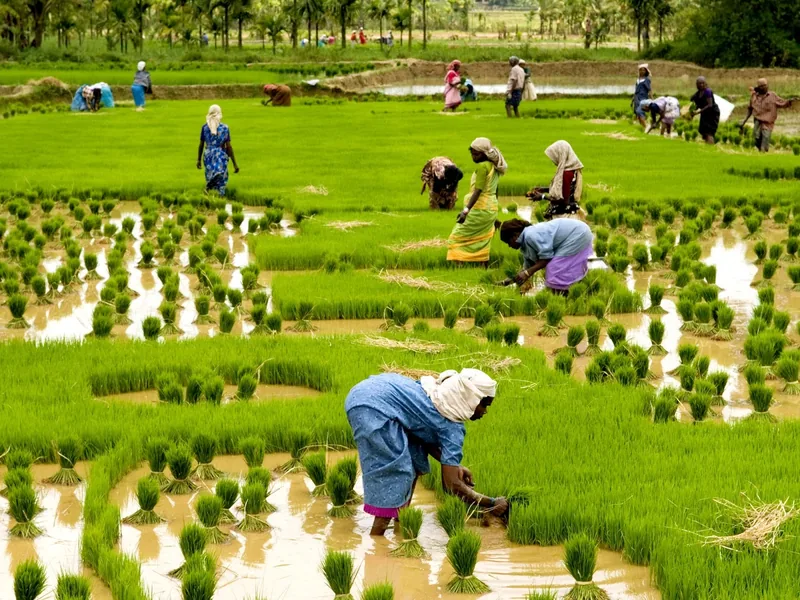
Farmers preparing rice seedlings in a Kuttanad padasekharam.
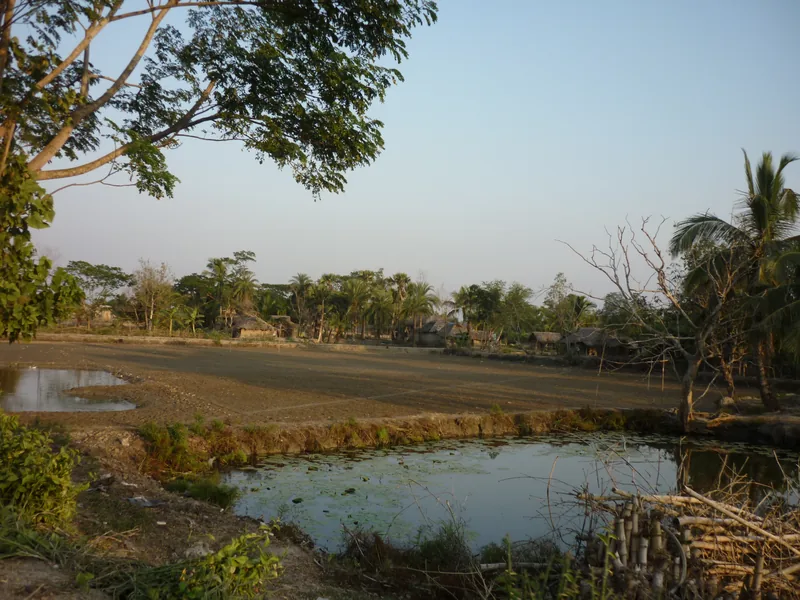
Sundarbans countryside — peaty-marshy delta with tide-influenced fields.
Profile showing the dark peat layer over a grey marine clay sub-base.
ICAR-NBSS&LUP
In hand: deep black, fibrous, smells of old leaves and damp.
Mohan-uploaded (placeholder)
⚖️ Physical character
How it handles
Texture
Variable — peaty topsoil over silty marine clay sub-base; the texture changes by depth, not by field
Structure
Spongy when wet, fibrous; shrinks and cracks if drained. The drying is irreversible — once the peat oxidises, it doesn't come back
Depth
Peat layer 30 cm to several metres deep depending on location; underlying marine clay extends much further
Drainage
Permanently or seasonally waterlogged. Drainage is part of the cropping cycle, not a one-time fix
Water-holding (mm/m)
Effectively saturated — the field is more often a wet sponge than a soil with measurable WHC
Working the soil: The work here is water management, not soil tillage. Bunds, sluice gates, and pumping schedules matter more than tractors. Don't drain too far — exposed peat oxidises into acid sulphate, and the field never recovers.
🧪 Chemical character
The science behind it
pH range
4.0–5.0 when waterlogged; can drop to 3.0 when drained (acid sulphate). Sundarbans saline patches: 6–7.
EC (dS/m)
Low in fresh-water peat; high in tidal Sundarbans during dry months
CEC (meq/100g)
30–80 meq per 100 g — very high (the peat itself is the holder)
Free CaCO₃
Generally absent; the soil is acid
Scientific name: Soil scientists call peat-dominated profiles {{nt:Histosols}}. When drained and oxygenated, the buried sulphur becomes acid sulphate — earning the name {{nt:cat-clay}} in old Kuttanad accounts.
🌿 Nutrient status
What's plenty, what's missing
Typical nutrient picture for this soil. For your specific field, always get the ICAR Soil Health Card.
5–25%
Among the highest in any Indian soil — that's the peat itself. Don't drain it dry; that destroys the very thing that makes the soil hold.
Plenty of N in organic form, but locked up by waterlogging and acidity. A small starter dose of urea at transplanting helps the rice take off.
Severely tied up by the soil's acidity and by iron at the surface. Lime is the lever; without it, even heavy P doses feed the soil more than the plant.
Variable. Coconut on raised mounds shows potassium-shortage symptoms (leaf-margin burn) frequently in Kuttanad.
S is more of a hazard than a nutrient here — buried sulphides oxidise to acid sulphate when drained. Don't add gypsum; manage the watertable instead.
Common deficiency in lowland rice on peat. Zinc sulphate at transplanting almost always pays back.
Iron toxicity is the bigger problem, not Fe shortage. Standing-water rice goes bronze and stunted when Fe rises too high — alternate wetting and drying helps.
Variable — confirm with a soil test before adding. Coconut on raised pits sometimes shows split nuts where B is short.
☔ Climate & water
What this soil expects
Rainfall this soil expects
Peat-marsh sits in high-rainfall belts: Kuttanad gets 2,500 to 3,500 millimetres a year, Sundarbans 1,500 to 2,000, Brahmaputra valley 2,000 to 3,000. Rainfall is rarely the limiting factor — what matters is whether the field is above or below the seasonal watertable, and whether tide brings salt.
Irrigation — what crops need on this soil
The 'irrigation' on peat-marsh is reverse-irrigation: pumping water OUT in the dry-season Kuttanad punja, holding bund integrity against the Sundarbans tide. Kuttanad's padasekharams operate on a community pumping schedule; Sundarbans depends on embankment maintenance. Drip and sprinkler are irrelevant; gravity, sluices, and pump-houses are the real water infrastructure.
Climate zones this soil sits in
Hot per-humid (Kuttanad backwaters), hot sub-humid coastal (Sundarbans), warm humid (NE wetlands and coastal Odisha swamps). High humidity year-round; long warm winters. The climate that makes the peat wants to keep it wet — fighting that is what the management practices are for.
🌾 Crops
What grows well here
Lowland rice is the only major cereal that thrives in standing water. Peat-marsh fields are rice country, almost by default.
Tip: Use varieties bred for the local depth and salinity. In Kuttanad, watch for iron toxicity (bronzing); in Sundarbans, use salt-tolerant varieties.
Tolerates the brackish watertable when planted on raised mounds above the field level.
Tip: Plant in mounds 60–90 cm above the field surface; mulch husk back annually; never let the rootzone sit in salt water.
On the raised bunds and dryer fringes of padasekharams, tapioca tolerates the acidic peat better than most starch crops.
Tip: Plant on the bund tops or on raised beds; avoid the field interior where waterlogging persists.
Loves the wet-then-dry rhythm of pre-monsoon and monsoon on alluvial-peat margins.
Tip: Sow with the first pre-monsoon shower; retting needs clean still water at harvest.
Tolerates acidity better than most fruits; the spiny leaves shed water from heavy rain.
Tip: Plant suckers on the higher, better-drained patches; standing water kills pineapple roots.
Loves the well-drained patches of peat margins where the topsoil is rich in humus.
Tip: Plant on raised beds 30 cm high — never in the swampy interior. Lift before the heaviest rains end.
🍂 Deficiency signs
What the plant tells you
If you see these in your field, get your soil tested before adding inputs.
Iron toxicity (not deficiency)ఇనుము విషప్రభావం
Rice goes bronze, stunted, with leaf-tip burn — the field has too much iron in the standing water, not too little.
Iron-toxic rice in a Kuttanad padasekharam — bronze leaves, stunted plants.
ICAR-CRRI / KAU
What to do: Drain the field briefly, then re-flood — alternate wetting and drying. Don't add iron; the soil already has too much. Use varieties bred for iron tolerance where available.
Acid sulphate damage when drainedఎండిన పీట్ నేలలో ఆమ్ల సల్ఫేట్ నష్టం
After hard drying, the peat field turns very acidic; the topsoil pH can drop below 4. Crops fail; new roots burn.
Illustrative — actual symptoms vary. Acid-sulphate rice: yellowing, stunting, root burn after the field dried out too far.
ICAR-CRRI (illustrative)
What to do: The cure is prevention — keep the watertable controlled, never let the peat dry out fully. If damage has happened, lime heavily and re-flood for a season before cropping again.
Phosphorus and Zinc deficiency in lowland riceవరిలో ఫాస్ఫరస్ మరియు జింక్ లోపం
Rice tillering is weak; lower leaves dull, plants short. Peat-soil rice often shows both P and Zn shortage together.
Phosphorus-deficient rice on Kuttanad peat — older leaves dull purple, weak tillering.
KAU Vellanikkara
Zinc-deficient rice on the same field — bronze patches between leaf veins.
ICAR-CRRI Cuttack
What to do: Lime first to raise the soil's comfort. Drop new P beside the seedling, not broadcast. 25 kg of zinc-sulphate per acre at transplanting covers two to three seasons.
🛠️ Management
Practices that work for this soil
🚪Bunding and controlled drainage
గట్లు మరియు నియంత్రిత నీటి తీసివేత Maintain strong perimeter bunds; install simple sluice gates to control the watertable; never let the peat dry out below 30 cm.
Why it helps: The peat is the soil's wealth. Drying it out fully turns it into acid sulphate, and the field never recovers. Controlled drainage holds the watertable just below the root zone — wet enough to protect the peat, dry enough for the crop.
⚪Lime once every 2–3 years
ప్రతి 2–3 సంవత్సరాలకు సున్నము Apply 500 kg–1 tonne of agricultural lime per acre, mixed into the topsoil, once every 2–3 years.
Why it helps: When peaty soil dries out and oxygen reaches the buried sulphur, the soil suddenly turns very acid — what farmers call {{nt:cat-clay}}. Once it happens, the field is hard to bring back. Lime ahead of dry-down is the cheap insurance.
🐟Integrated rice and fish
వరి–చేపల సహ-సాగు Combine the rice cycle with a fish (or prawn) cycle in the same field — rice in monsoon, fish in the post-rice flooded months.
Why it helps: Two harvests from the same field, each helping the other. Fish eat insect larvae; their waste fertilises the rice. The integrated system has been practised in Kuttanad for generations and is now actively researched for export.
🌾Salt-tolerant rice for tide-influenced fields
ఉప్పునీటి ప్రభావిత పొలాలకు ఉప్పు తట్టుకునే వరి Use varieties bred for salinity tolerance — Canning-7, Lunishree, or local landraces in Sundarbans; flood-tolerant varieties for the deeper-water fields.
Why it helps: In Sundarbans, the dry-season tide brings brackish water to the field. Only salt-tolerant rice yields under that stress. Each district has its own well-adapted variety — your local Krishi Vigyan Kendra or rice research station has the seed.
⛰️Raise mounds for tree crops
చెట్ల పంటలకు ఎత్తయిన గట్లు For coconut, banana, and any other tree crop, plant on mounds 60–90 cm above the field level, made of dredged silt and topsoil.
Why it helps: The mound keeps the rootzone above the saline or acidic watertable. Without the mound, even tolerant trees fail in 3–5 years. Mounds also catch farmyard manure and mulch better than flat ground in a wet field.
🏛️ Government schemes
Support you may be eligible for
Note: Officially listed under 'Histosols' on government portals; drained-and-oxidised patches reclassified as acid sulphate ('Sulphaquepts').
Kuttanad Package
Government of Kerala (post-Swaminathan 2008 report)
Lime subsidy, pump-house upgrades for padasekharams, salinity-control sluices, irrigation infrastructure for below-sea-level rice farming.
Visit portal →KIIFB Kuttanad Rejuvenation Programme
Kerala Infrastructure Investment Fund Board
Capital programme for bunds, pumps, sluices, and dredging in Kuttanad's padasekharams. Rolls out alongside the Kuttanad Package.
Visit portal →Kerala Land Reclamation & Development Corporation
Government of Kerala
Operating arm for the reclaimed kayal lands; coordinates pumping, bunding, and rotational rice–fish farming in Kuttanad.
Visit portal →Sundarbans Mangrove & Bio-shield Conservation
Government of West Bengal + Forest Department
Mangrove plantation along the embankments — buffers cyclone storm surge that otherwise floods peaty paddy fields with saltwater.
Visit portal →💭 Common beliefs
What we hear — and what's true
If I drain the field harder, the soil will dry out and farm like normal land.
Hard drying of peat triggers a chemical reaction farmers in old Kuttanad called 'cat-clay' — buried sulphides oxidise and the topsoil pH crashes below 4. Roots burn; the field becomes useless for years. The peat that holds the soil together is only stable while wet. Drainage on these soils is calibration, not removal — pull the watertable just below the root zone, never lower.
Why it matters: An acid sulphate field can take 5 to 10 years to recover, and only with heavy lime applications. Kuttanad's pumping calendar — dewater in November–December for punja rice, re-flood for the post-harvest months — is precisely calibrated to keep the watertable low enough to crop but high enough to protect the peat. The Kuttanad Package and the Kerala Infrastructure Investment Fund Board's rejuvenation programme exist to maintain this exact balance.
My rice is going bronze — it must need iron, I'll spray iron sulphate.
On peat-marsh, bronze rice is almost always iron TOXICITY, not deficiency. The standing water keeps iron in a form the plant takes up too easily. Adding more iron makes it worse. The cure is alternate wetting and drying — let the field dry to a workable surface, then re-flood. Where rotation isn't possible, iron-tolerant rice varieties from ICAR-CRRI Cuttack are the answer.
Why it matters: Misdiagnosing iron toxicity as iron deficiency wastes the spray AND worsens the crop. The same bronze symptoms can also signal phosphorus or zinc shortage, and the tests are different. A Soil Health Card test on a peat-marsh field before the first season's spray is one of the cheapest insurance buys in farming.
The bund is the village's responsibility — I'll deal with my field, the others can deal with theirs.
On peat-marsh, one weak bund segment floods the entire padasekharam or embankment block. Saltwater intrusion in the Sundarbans, brackish-water rise in Kuttanad — both spread laterally because the soil is permeable. Bund maintenance is a collective good: the strongest farmer cannot keep his crop if the weakest neighbour's bund fails. Padasekharam committees and Sundarbans embankment co-operatives exist because individual farming on these soils does not work.
Why it matters: A single failed bund segment can wipe out a year's crop across hundreds of acres — that's the recurring lesson of every Kuttanad pump-house failure and every Sundarbans cyclone breach. The Kuttanad Package, the Kerala Land Reclamation & Development Corporation, and the West Bengal Coastal Embankment Improvement Project all subsidise collective infrastructure for this reason — but only the local farmer-committee can keep up the day-to-day maintenance that keeps the system honest.
📚 Sources
Where this comes from
Sourced only from ICAR, NBSS&LUP, SAU, KVK, and ICRISAT. Wayback Machine snapshot links preserve citations against URL rot.
bookMishra, B.B. (Ed.). (2020). The Soils of India. Springer Nature Switzerland.
Canonical contemporary Indian soil science reference; peaty/marshy coverage limited — KAU Kuttanad is the primary anchor.
university-pubKuttanad rice — package of practices
link extension-pubCoastal and salt-affected rice — variety bulletin
link extension-pubSundarbans agriculture — salt-tolerant varieties and tidal management
link government-portalSoil Health Card scheme — find your nearest test centre
link
A note — This page is an educational guide built from public extension materials. It is not a prescription. Your soil is unique. For specific fertilizer or amendment decisions, get your soil tested and consult your nearest KVK or local agriculture extension officer.