Primary states
Tamil Nadu, Karnataka (south), Andhra Pradesh (Rayalaseema), Telangana
Texture
Light to medium — sandy loam to red loam; gravelly on plateau edges
pH
5.5–6.5 (slightly acidic)
🗺️ Where you'll find it
Geography
Covers about 26.8% of India's land. Found mainly across Tamil Nadu, Karnataka (south), Andhra Pradesh (Rayalaseema), Telangana, Odisha, Chhattisgarh, eastern Madhya Pradesh, Jharkhand.
Rayalaseema & Mysore plateau
Drought-prone red soil, often shallow on plateau edges. Groundnut–pulse–ragi belt; mango and citrus on better-drained patches.
Tamil Nadu hinterland & Cauvery margins
Mostly red sandy loam. Tank-fed and well-irrigated. Tapioca, banana, turmeric, hybrid maize, and small-holding poultry-feed crops.
Bundelkhand & Chhotanagpur fringe
Shallower, gravelly, often rocky outcrops. Rainfed pulses, oilseeds, and minor millets dominate. Erratic rains make crop choice the central question.
👁️ Look & Feel
What you see, what you feel
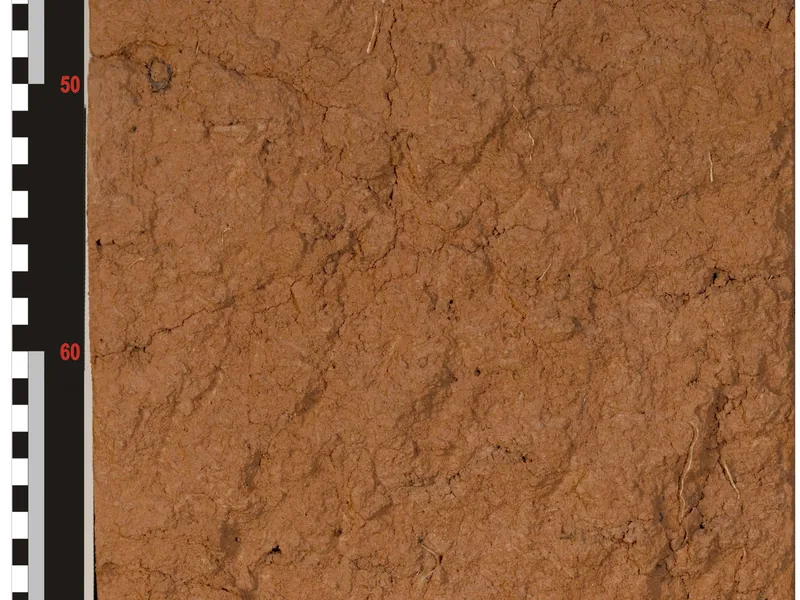
Look at the soil after the first plough of the season. The freshly turned earth is the colour of old brick — sometimes red, sometimes a yellow-orange where iron has weathered differently. Walk a few fields over, and the colour shifts again. This is a soil that wears its iron on its sleeve. On the Deccan, walk uphill and the soil stays red; walk down to the valley and it turns black — same district, different soil born from different rocks.
Freshly ploughed red soil before kharif — Anantapur, August.
Wikimedia Commons (CC-BY)
Yellow-orange patch where the iron has weathered to limonite — eastern MP.
ICAR-NBSS&LUP
Soil monolith — Lixisol (red-soil order) from Karnataka, ISRIC reference collection.
In hand: gritty, friable, holds together loosely when squeezed.
Mohan-uploaded (placeholder)
⚖️ Physical character
How it handles
Texture
Light to medium — sandy loam to red loam; gravelly on plateau edges
Structure
Loose, single-grained; rarely forms strong clods
Depth
Shallow on hilltops (30–60 cm), medium-to-deep in valleys and pediments
Drainage
Excessive in coarse patches; shallow soils dry out quickly between rains
Water-holding (mm/m)
70–130 mm — low; tank irrigation or well water makes a big difference
Working the soil: Easy to work in any moisture condition. The trade-off is that it dries out fast — every rainless week shows up in the crop.
🧪 Chemical character
The science behind it
pH range
5.5–6.5 (slightly acidic)
EC (dS/m)
Below 0.5 dS/m typically; salinity is rare on these soils
CEC (meq/100g)
5–15 meq per 100 g — low; fertiliser leaks past quickly if not split
Free CaCO₃
Generally absent; the soil is mildly acidic, not calcareous
Scientific name: Soil scientists classify these as Alfisols — soils with enough clay and base nutrients to support cropping, weathered from acidic igneous rocks like granite and gneiss.
🌿 Nutrient status
What's plenty, what's missing
Typical nutrient picture for this soil. For your specific field, always get the ICAR Soil Health Card.
0.2–0.4%
Heat and good drainage burn through organic matter fast. Farmyard manure, compost, and crop-residue mulch are the only durable answer.
Rains wash N past the roots on these light soils. Split your N into 2–3 doses; never broadcast it all at sowing.
P is locked up by the soil's acidity. Drop it in a line beside the seed; a small dose of lime (where available) helps free up the P that's already in the ground.
Lower than black or alluvial. Pulses and oilseeds in particular respond to a small K dose at sowing.
Groundnut, ragi, and pulses respond strongly. Yellowing of new leaves (not the old ones) is the sign.
Less common than on alluvium; check on continuously cropped fields. White streaks on young maize is the warning.
Plenty of iron — that's where the colour comes from. Iron shortage is rare.
Groundnut shows hollow heart, brinjal shows fruit cracking. A pinch of borax at sowing solves it for the season.
☔ Climate & water
What this soil expects
Rainfall this soil expects
Red soil is spread across hot semi-arid (Rayalaseema, parts of Karnataka, Tamil Nadu hinterland) and hot sub-humid zones (Chhattisgarh, Jharkhand, Bundelkhand). Most red-soil belts get less than 1000 millimetres of rain a year, and that rain comes in unreliable bursts. The shallower the soil, the harder a dry spell hits the crop.
Irrigation — what crops need on this soil
Tank-fed and well-fed irrigation is the long tradition; canal irrigation is scarce on most of these plateau soils. Drip and sprinkler pay back fast on red soil because flood irrigation leaks through the loose texture. On Bundelkhand and Chhotanagpur fringes, where water is hardest to find, deep-rooted rainfed crops are the only durable answer.
Climate zones this soil sits in
Hot semi-arid (Rayalaseema, Mysore plateau, Tamil Nadu hinterland), hot sub-humid (Chhattisgarh, Jharkhand, eastern Madhya Pradesh, Bundelkhand). Long warm winters across most of the south allow a rabi crop on residual moisture; the harder, drier Bundelkhand winters limit rabi options.
🌾 Crops
What grows well here
Light, friable soil lets pegs push down to form pods cleanly.
Tip: Add gypsum at flowering — the calcium goes into the pods, not just the leaves.
Drought-tolerant millet that gives a good crop on poor red soil with little water.
Tip: Sow with the first reliable rain; ragi survives dry spells most cereals can't.
Rabi pulse on residual moisture; brings free nitrogen back to a tired soil.
Tip: Coat seed with rhizobium powder. Avoid waterlogged patches — chickpea wilts in poor drainage.
Deep tap-root reaches sub-soil moisture; tolerates the long dry spells these regions get.
Tip: Often intercropped with maize or jowar — the pulse shares free nitrogen with its neighbour.
Hybrid maize on irrigated red loam gives strong yields where water reaches.
Tip: Watch for boron and zinc gaps; maize on continuously cropped fields will show streaks.
Andhra dry chillies (Guntur belt fringes) thrive on red soil under tank irrigation.
Tip: Drip irrigation pays back fast on these light soils — water and fertiliser both reach the root zone better.
Friable soil drains well, no clods to bruise tubers — and the warm winters suit a long crop.
Tip: Stake or trellis to keep fruit off the soil. Mulch holds moisture between irrigations.
Deep red loam in the valleys gives a deep root run. Mango is a long-life crop on these soils.
Tip: Plant grafts in pits 1 m × 1 m × 1 m, filled with topsoil + 25 kg of farmyard manure. Don't intercrop too close to the trunk in mature years.
🍂 Deficiency signs
What the plant tells you
If you see these in your field, get your soil tested before adding inputs.
Phosphorus deficiencyఫాస్ఫరస్ లోపం
Old leaves turn dull purple or bronze; plants stay short and slow to flower. Common on acidic red soil where lime is absent.
Phosphorus-deficient ragi: leaves with a dull purple tinge at the base.
UAS Bangalore
Illustrative — actual symptoms vary. Stunted groundnut with dull bronze leaves.
ICAR-DGR (illustrative)
What to do: Drop fertiliser in a line beside the seed — not scattered — and more of it reaches the plant. A small dose of lime, where you can get it, frees up the P already in the ground.
Boron deficiencyబోరాన్ లోపం
Groundnut pods are empty ("hollow heart"); brinjal fruits crack; cauliflower shows brown patches in the curd.
Groundnut hollow-heart symptom — empty kernels in shell.
ICAR-DGR Junagadh
Illustrative — actual symptoms vary. Brinjal fruit cracking from boron shortage.
ICAR-IIHR (illustrative)
What to do: A small pinch of borax at sowing solves it for the season. Don't overdo — too much boron also damages the crop.
Sulphur deficiencyగంధకం లోపం
Top leaves yellow first — the opposite of nitrogen, where lower leaves go yellow.
Sulphur-deficient groundnut: pale top leaves, lower leaves still green.
ICAR-DGR Junagadh
Illustrative — actual symptoms vary. Sulphur-deficient ragi: yellowing top leaves.
UAS Bangalore (illustrative)
What to do: Gypsum or single super-phosphate (which carries sulphur) at sowing fixes it. Groundnut especially responds — both for the leaves and for the pods.
🛠️ Management
Practices that work for this soil
🪣Tank de-silting and tank-bed cropping
చెరువు తీసి బురద పొలాలకు తెచ్చుట Every 3–5 years, dig out the silt that builds up in the village tank and spread it on red-soil fields nearby.
Why it helps: Tank silt is rich in fine clay and organic matter that has washed off the catchment. It's the cheapest soil amendment available — and it restores the tank's storage too.
💧Drip irrigation on row crops
డ్రిప్ నీటిపారుదల Lay drip lines along the crop rows; deliver water and fertiliser through the same line, in small daily doses.
Why it helps: Light red soil leaks water and nutrients past the roots when flooded. Drip puts both right at the root, doubling the yield per litre and per kilo of fertiliser.
⚪Lime where it's available
సున్నము చేర్చడం 200–500 kg of agricultural lime per acre, mixed into the topsoil before sowing, once every 3–5 years.
Why it helps: In red soil, phosphorus gets locked up by iron. A handful of lime every two or three years opens that lock — your di-ammonium phosphate and single super-phosphate go further.
🌾Mulch with crop residue
పంట అవశేషాలతో మల్చింగ్ Spread last season's straw, ragi husk, or groundnut shells on the soil between crop rows — about 5 cm thick.
Why it helps: Mulch keeps the soil cool and damp between rains. On a soil that dries out fast, this is the difference between a crop that holds and a crop that wilts in the dry spells.
🔄Pulse–cereal–oilseed rotation
పప్పు–ధాన్యం–నూనె గింజ మార్పిడి Rotate every year — pulse one season, cereal the next, oilseed the third. Don't grow the same crop twice in a row.
Why it helps: Each crop uses different nutrients and breaks up the previous crop's pest cycle. Pulses bring free nitrogen back. The next cereal grows better on a pulse residue than on its own residue.
🏛️ Government schemes
Support you may be eligible for
Note: Officially listed under 'Alfisols' / 'Ultisols' on government portals.
National Food Security Mission — Nutri-Cereals (Ragi, Jowar, Bajra)
Department of Agriculture & Farmers Welfare
Seed and production support for finger millet, sorghum, and other coarse cereals on red soils.
Visit portal →Mission for Integrated Development of Horticulture
Department of Agriculture & Farmers Welfare
Subsidies for mango, citrus, vegetable cultivation; drip irrigation; cold-chain.
Visit portal →Accelerated Irrigation Benefit Programme — Tank rejuvenation
Ministry of Jal Shakti + state irrigation departments
De-silting and revival of village tanks; the silt itself goes back to surrounding red-soil fields.
Visit portal →💭 Common beliefs
What we hear — and what's true
Red soil is poor soil — there's nothing I can do, the rains decide everything.
Red soil's main weakness is capacity, not fertility — it leaks water and nutrients because it's light and slightly acidic. Tank silt, a small dose of lime, mulching with crop residue, and drip irrigation each plug a different leak. Farmers in Anantapur and Kolar who do all four together have moved their groundnut yields from 700 to 1100 kilograms an acre on the same rainfall.
Why it matters: The cost of leaving red soil 'as it is' is a yield ceiling that doesn't lift even in a good rain year. The cost of treating it — lime once in three years, tank silt once in three to five years, mulch every season — is small. The Mission for Integrated Development of Horticulture and the National Food Security Mission both subsidise inputs that move red-soil yields up.
Drip irrigation is for tomato and grape farmers — my groundnut and ragi don't need it.
Light red soil leaks water past the roots when flood-irrigated. The same litre of canal or borewell water through drip reaches the root zone, where the crop actually uses it. Field trials on red-soil groundnut and chillies show drip saving water and increasing yield together — both, not one or the other.
Why it matters: On a shrinking borewell, the choice isn't drip-versus-flood; it's drip-versus-no-crop-next-summer. Pradhan Mantri Krishi Sinchayee Yojana — Per Drop More Crop subsidises drip systems for smallholder fields, often covering more than half of the system cost. Most state agricultural departments add to it.
Lime is for tea estates up north — our Andhra red soil doesn't need it.
Red soil pH typically sits between 5.5 and 6.5 — that is acidic. The acidity locks phosphorus into a form the crop can't reach. So you spend money on di-ammonium phosphate and single super-phosphate, and most of it stays in the soil unused. A small dose of agricultural lime — 200 to 500 kilograms an acre, once every three to five years — opens that lock.
Why it matters: Without lime, you are paying for phosphorus that never reaches the crop. With lime, the same di-ammonium phosphate and single super-phosphate dose gives noticeably better response. Lime is one of the cheapest interventions in farming — and one of the least used in southern red-soil belts because the habit hasn't spread.
📚 Sources
Where this comes from
Sourced only from ICAR, NBSS&LUP, SAU, KVK, and ICRISAT. Wayback Machine snapshot links preserve citations against URL rot.
bookMishra, B.B. (Ed.). (2020). The Soils of India. Springer Nature Switzerland.
Canonical contemporary Indian soil science reference.
extension-pubDryland agriculture on red soils
link university-pubRagi (finger millet) package of practices
link government-portalSoil Health Card scheme — find your nearest test centre
link
A note — This page is an educational guide built from public extension materials. It is not a prescription. Your soil is unique. For specific fertilizer or amendment decisions, get your soil tested and consult your nearest KVK or local agriculture extension officer.